


8 Factors That Shorten the Life of Recycling Machine Blades
Introduction
You run a recycling operation, so you already know blades are consumables. They wear out. That's just part of the job.
But here's what doesn't feel normal: when a set of granulator knives that used to last three months suddenly needs changing every three weeks. Or when your shredder blades show uneven wear patterns you can't explain. Or when you're buying industrial blades for recycling more often than your budget can handle.
We've spent years walking through recycling facilities, talking with operators, and studying how recycling machine blades actually perform in real-world conditions. Not lab tests. Not marketing claims. Real floors with real dust, real contamination, and real production pressure.

Here's what we've learned: blade life is rarely just about blade quality. More often, it's a combination of factors-some obvious, some hiding in plain sight. And the good news? Most of them are things you can actually do something about.
This guide walks through eight factors that consistently show up in our customer conversations. Use it as a troubleshooting checklist the next time you see blade wear happening faster than it should.
1. Contamination in the Feedstock
What we see in the field: A facility processing electronic waste calls us about edge chipping on blades that normally handle the material just fine. The only thing that changed? A new batch of shred came in with small steel brackets still attached.
Hard contaminants are the fastest way to kill industrial blades for recycling. We're talking about:
Metal fragments-bolts, screws, wire pieces that slipped through sorting
Sand or small stones-especially common in agricultural film recovery
Glass particles-from poorly sorted bottle streams
Ceramics or circuit board fragments-the kind that show up in e-waste
How it shows up on the floor: You'll see visible nicks along the cutting edge. Or wear patterns that look uneven-heavier on one side than the other. In extreme cases, you get chipping that makes the blade unusable long before it should be.
Check this first: Walk your front-end sorting line. Is the magnetic separator positioned correctly? Are the screens catching small contaminants before they reach the shredder? Sometimes the issue isn't more contamination-it's that an existing separator got moved during maintenance and nobody realized it.

2. Moisture in the Material
What we see in the field: A recycler processing post-consumer film keeps telling us their crusher blades look "rusty" between sharpenings. The film comes from outdoor bales stored uncovered. They assumed moisture didn't matter because "it's just plastic."
Moisture damage is sneakier than contamination. You don't see it happening, but the effect adds up over time.
How it shows up on the floor: The blade surface develops a dull, pitted appearance-almost like mild corrosion. In the cutting chamber, you might notice material sticking or building up where it shouldn't. Wet material combined with the heat from cutting creates a mild corrosive environment. The blade isn't wearing evenly; it's corroding microscopically between passes.
Common culprits we see: Outdoor storage, washed materials that didn't dry fully, or humid climates where condensation forms on stored feedstock overnight.
Check this first: Grab a handful of material and squeeze. Does it feel damp? Look at the storage area-are bales sitting directly on wet ground? For wash lines, check if the drying stage is keeping up with throughput.
3. Mismatch Between Blade Material and Input
What we see in the field: A customer switches from processing HDPE bottles to glass-filled nylon automotive parts. They keep using the same D2 steel blades. Life drops by two-thirds, and they're frustrated with "poor blade quality."
Here's the thing: no single blade material handles everything. That's not a limitation-it's just physics. Different materials interact with steel in different ways.
How it shows up on the floor: You're getting consistent wear patterns, but they're happening too fast. Or you're seeing edge breakdown that looks different from what you're used to. Here's a rough guide based on what we see working in the field:
Standard plastics (PE, PP, PET bottles): D2 or SKD-11 tool steel is the industry standard. It offers the right balance of hardness and toughness for clean applications.
Glass-filled or mineral-filled materials: The glass fibers act like sandpaper on cutting edges. Standard tool steel wears fast here. Options like CPM 10V (powder metallurgy) or carbide-tipped blades handle abrasion much better.
Heavy impact applications: Sometimes you need toughness more than hardness. Thick-walled parts or materials with occasional metal contamination benefit from blade steels formulated for impact resistance rather than maximum wear life.
Check this first: Has your input stream changed in the last six months? If you're running different materials now than when you bought the blades, your blade material selection may need to catch up.
4. Improper Blade Gap Adjustment
What we see in the field: A granulator operator complains about excessive dust in their regrind. They've tried different screens, different speeds-nothing helps. We check the rotor-to-bed knife gap and find it's nearly twice what it should be.
The gap between rotating and stationary knives is probably the most influential setting you control. And it's often the most neglected.
How it shows up on the floor, gap too wide: Material folds over instead of cutting cleanly. You get more elongated particles, higher dust generation, and the motor works harder because it's tearing rather than shearing.
How it shows up on the floor, gap too tight: You risk metal-on-metal contact, which generates heat, causes blade wear to accelerate, and can lead to catastrophic damage if it goes unnoticed.

General starting points for granulator knives based on what we see working:
- Rigid plastics (purge, thick parts): 0.5mm – 1.0mm
- Bottles and containers: 1.0mm – 2.0mm
- Films and bags: 0.3mm – 0.5mm
Check this first: Grab a feeler gauge and check clearance at multiple points along the blade length. It should be consistent within 0.05mm across the whole width. If it's not, something's out of alignment.
5. Inconsistent Feeding
What we see in the field: A dual-shaft shredder keeps losing edges on its hooked blades. The operator points to blade quality. But watching the line for ten minutes tells a different story: they're dumping full gaylords into the hopper all at once, then waiting, then dumping again.
Recycling machine blades are designed for steady work, not shock loads.
How it shows up on the floor: You'll see irregular wear patterns, sometimes with small fractures or chipping that don't follow a consistent pattern across all blades. The motor amps spike dramatically during feeding, then drop to near idle.
When you overload the chamber, the rotor slows, torque spikes, and blades experience forces outside their design range. Do it repeatedly, and you shorten blade life regardless of material quality.
Check this first: Watch the operation for fifteen minutes. Is feed rate consistent? Does the conveyor match the shredder's rated throughput, or is someone manually feeding in bursts? Sometimes the fix is as simple as adjusting a feeder speed.
6. Blades Not Rotated
What we see in the field: A facility replaces square shredder blades every time they dull-tossing blades that still have three unused edges. When we ask about rotation, they say, "We didn't know you could do that."
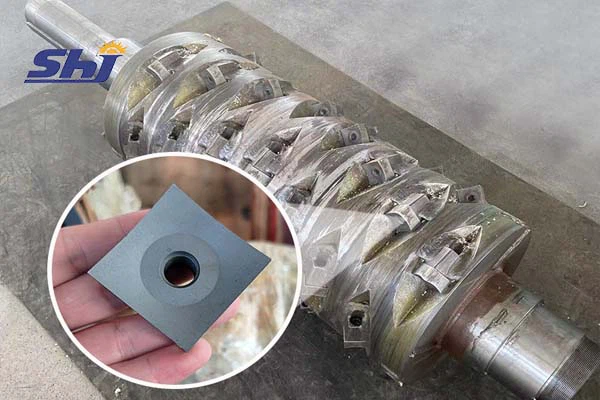
Many industrial blades for recycling are designed with multiple cutting edges. Single-shaft shredder knives are often four-sided. Granulator rotors typically hold multiple knives that can be swapped positionally.
How it shows up on the floor: You're throwing away blades that still have 50-75% of their useful life left. It's not a wear issue-it's a utilization issue. And it's costing you money.
Check this first: Look at your last five blade change records. Does everyone on the crew know which blades can be rotated and how to do it safely? Is rotation part of your scheduled maintenance, or does it only happen when someone remembers?
7. Operating Outside Design Parameters
What we see in the field: Thin-film granulator blades installed in a machine processing thick-wall pipe fittings. Same machine, same RPM-completely different application. The blades chip within days, and everyone's confused.
Every blade has a job it was designed for. Thickness, rake angle, clearance angles-these aren't random numbers. They're engineered around expected material types and feed rates.
How it shows up on the floor: Consistent failure patterns. If you're getting the same type of wear or breakage across multiple blade sets, you're probably asking the blades to do something they weren't designed for.
Examples we've seen in actual facilities:
Using low-angle knives designed for film on rigid materials-the edge crumbles
Using heavy-duty granulator knives in a high-speed application-excessive heat buildup
Running blades rated for clean material in contaminated streams-rapid dulling
Check this first: Pull the spec sheet for your current blades. What materials were they designed to process? Does that match what you're actually running today?
8. Ignoring Early Warning Signs
What we see in the field: A maintenance manager tells us their blades "fail suddenly with no warning." But the operators have been hearing a different sound from the granulator for two weeks. Nobody acted on it.
Blades almost never fail without giving clues first. You just have to know what to listen for.

The signs we tell customers to watch:
- Sound changes: A higher-pitched whine or a grinding rhythm that wasn't there before
- Vibration increases: Even small changes often mean an edge is dulling unevenly
- Motor amps creep up: Dull blades require more power to cut the same material
- More fines in the output: Worn blades tear rather than cut, generating more dust
- Throughput drops: You're processing fewer tons per hour with the same effort
Check this first: Do your operators know what "normal" sounds like? Do they have a way to report changes without jumping through paperwork? Sometimes the best "sensor" is a trained ear-if you give people permission to speak up when something sounds off.
Quick Troubleshooting Checklist
Next time you see blade wear that seems faster than it should be, run through this checklist in order:
Step 1: Look at the material
- Is it clean, or is there contamination you can see?
- Is it dry, or does it feel damp?
- Has the material type changed recently?
Step 2: Check the setup
- Are the blades the right grade for this material?
- Is the gap set correctly and evenly?
- Is feed rate steady, or does it surge?
Step 3: Review your records
- When were the blades last rotated?
- Has anyone reported unusual sounds or vibration?
- How does this set's performance compare to previous sets on similar material?
Frequently Asked Questions
How often should granulator blades be sharpened?
It varies widely with material. Clean corrugated might go 500+ hours between sharpening. Abrasive materials like glass-filled plastics might need attention every 100 hours or less. Track your amp draw-when you see a consistent 10-15% increase over baseline with the same material, it's time.
What causes blade chipping?
Most often, hard contaminants like metal or stone. Sometimes incorrect gap settings that allow blade-to-blade contact. Less common but possible: blade material too brittle for the application.
When should I replace blades instead of resharpening them?
When you've rotated through all available cutting edges. Or when the blade height is below the manufacturer's minimum spec. Also, if you see cracking or major chipping that extends past the wear zone.
Can D2 blades handle glass-filled plastics?
They can, but they'll wear faster than specialty grades. For occasional runs, D2 may be acceptable. For continuous glass-filled processing, consider upgrading to powder metallurgy steels like CPM 10V or exploring carbide-tipped options.
Conclusion
Recycling machine blades wear out-that's built into the economics of size reduction. But how fast they wear depends on a handful of factors you can actually control.
Next time blade life falls short of expectations, resist the urge to blame the blade supplier first. Run through this list. You might find the real issue isn't the steel-it's something upstream, something in the setup, or something in the routine.
And if you've checked everything and still aren't getting the performance you need? That's when a conversation about custom solutions makes sense. Different materials really do need different approaches. Sometimes a small adjustment in blade spec makes a big difference in outcome.
SHJ KNIFE manufactures precision industrial blades for recycling applications. If you're troubleshooting a specific wear issue and want an experienced perspective, reach out. We've seen a lot of recycling lines-and what we haven't seen, we're happy to learn alongside you.


