


Types of Shredder Blades: How to Choose the Right Industrial Shredder Blades
Introduction
Shredder blades may look simple from the outside, but choosing the right blade is rarely just about shape. In industrial recycling and waste processing, the correct shredder blade depends on the shredder machine structure, cutting method, material being processed, required output size, blade steel grade, hardness, tooth profile, and working conditions.
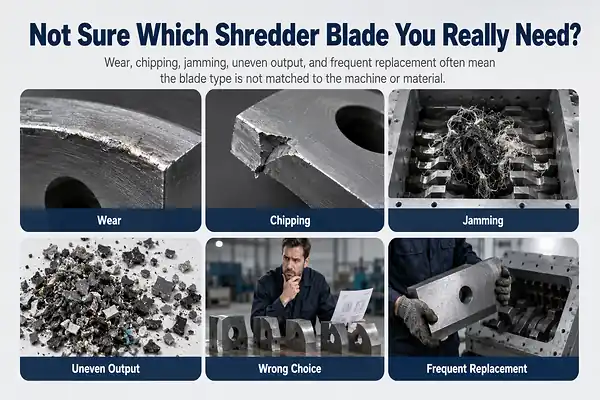
That is why many buyers search for types of shredder blades before placing an order. They may already have a shredder machine, a worn blade, a broken sample, or a drawing, but they are not sure how to describe the blade correctly or which material and design will work best.
At SHJ KNIFE, we manufacture custom industrial shredder blades, shredder knives, granulator knives, and recycling machine blades according to drawings, samples, machine models, and actual working conditions. This guide explains the main shredder blade types, how they work, where they are used, and what information is needed when ordering custom or replacement shredder knives.
Article Summary
- Introduction
- 1. What Are Shredder Blades?
- 2. Why Are There Different Types of Shredder Blades?
- 3. Types of Shredder Blades by Machine Design
- 4. Types of Industrial Shredder Knives by Function
- 5. Common Materials for Industrial Shredder Blades
- 6. How to Choose Shredder Blades for Different Materials
- 7. How to Select the Right Shredder Blades
- 8. Custom Industrial Shredder Blades from SHJ KNIFE
- 9. FAQ About Shredder Blade Types
- Conclusion
1. What Are Shredder Blades?
Shredder blades, also called shredder knives, shredder cutters, or industrial shredder blades, are cutting components used in shredding machines to reduce waste materials into smaller pieces.
They are widely used in plastic recycling, tire recycling, wood processing, metal recycling, e-waste recycling, municipal solid waste processing, RDF production, product destruction, and general industrial waste reduction.
Different shredder machines use different blade systems. Some machines use rotating knives and fixed counter knives. Some use intermeshing cutter discs on two shafts. Others use multiple shafts, screens, spacers, hook-type cutters, hammers, or granulator knives.
For this reason, understanding shredder blade types is not only useful for engineers. It also helps purchasing teams, maintenance departments, recycling plant operators, and OEM buyers avoid ordering the wrong replacement blade.
2. Why Are There Different Types of Shredder Blades?
Different shredder blades exist because different machines process materials in different ways. Some shredders use low-speed, high-torque tearing. Some rely on shearing between rotating and fixed knives. Some machines control particle size through screens. Granulators use sharper knives and tighter clearance for smaller regrind. Hammer mills reduce material mainly through impact and crushing.

In practice, shredder blades are usually classified by four main factors:
- Machine design, such as single-shaft, double-shaft, four-shaft, granulator, or hammer mill systems
- Blade function inside the machine, such as rotor knives, fixed knives, cutter discs, spacers, and hook-type cutters
- Blade material and heat treatment, such as D2, SKD11, Cr12MoV, H13, 9CrSi, 6CrW2Si, carbide-tipped blades, or manganese steel wear parts
- Material being shredded, such as plastic, tire, rubber, wood, metal, cable, e-waste, MSW, or RDF
A good blade selection should consider all of these factors, not only the blade shape.
3. Types of Shredder Blades by Machine Design
----Single-Shaft Shredder Blades
Single-shaft shredder blades are used in machines with one rotating rotor. The rotor is fitted with rotary knives, while fixed knives or counter knives are mounted inside the cutting chamber.
A hydraulic ram or pusher usually pushes the material toward the rotor. The rotating knives cut the material against the fixed knives. A screen below the cutting chamber controls the final output size.
- Rotor knives
- Rotary knives
- Fixed knives
- Counter knives
- Bed knives
- Screens and wear plates

Single-shaft shredder blades are often used when the customer needs more controlled particle size and stable regrind quality. Typical applications include plastic lumps, plastic pipes, plastic film, injection molding waste, wood waste, textile waste, rubber parts, light metals, and e-waste.
----Double-Shaft Shredder Blades / Twin-Shaft Shredder Cutters
Double-shaft shredder blades, also called twin-shaft shredder cutters, are mounted on two counter-rotating shafts. The cutter discs on each shaft intermesh with each other, pulling material into the cutting chamber and reducing it through tearing, shearing, and crushing action.
Compared with single-shaft machines, double-shaft shredders are usually used for heavy-duty primary size reduction. They are not mainly designed for fine and uniform output. Their main advantage is strong bite force, high torque, and the ability to handle bulky or difficult materials.

Common components include cutter discs, shredder cutters, spacer rings, hook-type cutters, shaft sleeves, and wear parts. Double-shaft shredder blades are widely used for scrap tires, plastic drums, wood pallets, metal scrap, cable waste, industrial waste, municipal solid waste, large plastic parts, and mixed waste.
The design of the cutter disc matters a lot. Tooth profile, hook angle, blade thickness, shaft clearance, spacer width, and heat treatment all affect cutting performance. For example, tire shredding often requires strong hook-type cutter geometry to grab the tire and resist impact from steel wire.
----Four-Shaft / Multi-Shaft Shredder Blades
Four-shaft shredder blades and multi-shaft shredder blades are used in machines that require stronger particle size control and more complete shredding inside the cutting chamber.
A four-shaft shredder normally has multiple intermeshing shafts. The material is pulled, cut, and recirculated until it is small enough to pass through the screen. This design combines primary and secondary shredding in one machine.
Four-shaft and multi-shaft shredder blades are commonly used for confidential document destruction, electronic media destruction, product destruction, rigid plastics, mixed waste, hazardous waste packaging, e-waste, and secure recycling applications.
----Granulator Blades / Granulator Knives
Granulator knives are often discussed together with shredder blades, but they are not exactly the same. A shredder is usually used for primary size reduction. A granulator is often used after shredding, especially in plastic recycling, to produce smaller and more uniform regrind.

Granulator knives usually include rotor knives, stator knives, bed knives, and screens. Compared with low-speed shredder cutters, granulator knives usually operate at higher speed and require sharper cutting edges, tighter clearance, and more accurate grinding.
They are commonly used for plastic flakes, injection molding scrap, plastic sprues, plastic film, small rubber parts, and secondary size reduction.
----Hammer Mill Cutting Parts
Hammer mill cutting parts are often mentioned in discussions about shredder blades, but their working principle is different. A hammer mill does not normally cut material in the same way as a single-shaft or double-shaft shredder. Instead, it reduces material mainly through impact, crushing, and repeated striking.
Common hammer mill wear parts include hammers, hammer tips, liners, screens, and wear plates. Hammer mills are often used for scrap metal, appliances, biomass, wood waste, hard or brittle materials, and auto recycling applications.
For buyers, the key point is this: hammer mill parts may be part of the same recycling equipment category, but they should not be selected with the same logic as sharp shear-cut shredder knives.
----Rotary Shredder Blades
The term rotary shredder blades usually refers to rotating knives mounted on a rotor or shaft. "Rotary" describes the movement of the blade, not always one specific shredder machine type.

Depending on the machine design, rotary shredder blades may work with fixed knives, counter knives, screens, spacer rings, or bed knives. When ordering rotary shredder blades, it is important to confirm the machine type, blade location, rotation direction, blade dimensions, cutting angle, and the material being processed.
4. Types of Industrial Shredder Knives by Function
Machine type is only one way to classify shredder blades. For replacement and custom manufacturing, it is often more useful to identify the blade's function inside the cutting chamber.
----Rotor Knives / Rotary Knives
Rotor knives are moving knives mounted on the rotor or shaft. They are the main cutting parts in many single-shaft shredders and granulators. They usually work together with fixed knives to create a shearing action. Their shape, edge angle, hardness, and mounting accuracy directly affect cutting efficiency and blade life.
----Fixed Knives / Counter Knives / Bed Knives
Fixed knives are stationary knives mounted inside the machine. They are also called counter knives or bed knives. Their job is to work against the rotating knives and create a clean cutting or shearing action.
If the fixed knife is worn, damaged, or incorrectly installed, the whole cutting system may lose efficiency, even if the rotor knives are new.
----Cutter Discs
Cutter discs are common in double-shaft and four-shaft shredders. They are usually mounted along the shaft in a stacked arrangement. The cutting performance depends on disc thickness, tooth number, hook profile, material, hardness, and the clearance between adjacent cutters.
----Spacers / Spacer Rings
Spacers are not cutting knives, but they are important in twin-shaft and multi-shaft shredder systems. They control the distance between cutter discs and help maintain proper cutting clearance. Poor spacer matching can lead to uneven cutting, machine vibration, jamming, or faster blade wear.
----Hook-Type Cutters
Hook-type cutters are designed to improve material grabbing ability. They are especially useful for materials that are slippery, flexible, or difficult to bite, such as plastic film, woven bags, rubber, tires, textile waste, and soft plastics.
5. Common Materials for Industrial Shredder Blades
There is no universal best material for shredder blades. The right steel grade depends on the material being shredded, impact load, contamination level, required hardness, wear resistance, toughness, and expected service life.

|
Material |
Common Use |
Main Advantage |
|
D2 / SKD11 |
Plastic, rubber, general recycling |
Good wear resistance and edge retention |
|
Cr12MoV |
Plastic waste, wood waste, rubber, mixed materials |
Balanced wear resistance and toughness |
|
H13 |
Impact, heat, or demanding working conditions |
Good toughness and thermal fatigue resistance |
|
9CrSi / 6CrW2Si |
General cutting knives and medium-duty blades |
Reliable performance with reasonable cost |
|
Carbide / Carbide-Tipped |
Abrasive materials |
Very high wear resistance |
|
Manganese Steel |
Impact-heavy wear parts |
Work-hardening under impact |
A blade that is too soft may wear quickly. A blade that is too hard may chip under impact. The right solution is usually a balance between hardness, toughness, wear resistance, and cost.
6. How to Choose Shredder Blades for Different Materials

----Plastic Shredder Blades
Plastic shredder blades are used for plastic lumps, pipes, purgings, film, sheets, and injection molding waste. Important blade requirements include sharp cutting edges, good wear resistance, stable hardness, proper clearance, smooth cutting surface, and the correct tooth profile for the plastic type.
----Tire Shredder Blades
Tire shredder blades must handle rubber, fabric, and steel wire. This makes tire shredding more demanding than cutting clean plastic. The blades need high torque cutting ability, hook-type cutter design, strong toughness, resistance to steel wire impact, and durable cutter discs and spacers.
----Metal Shredder Blades
Metal shredder blades are used for light metal scrap, aluminum profiles, cans, mixed metal waste, and other recyclable metal materials. These applications require strong impact toughness, heavy-duty cutter geometry, wear-resistant material, stable heat treatment, and strong blade body design.
----Wood Shredder Blades
Wood shredder blades are used for pallets, boards, branches, biomass, and wood waste. Clean wood and contaminated wood may require different blade choices. If nails, screws, sand, or soil are present, the blade material and hardness should be selected more carefully.
----E-Waste Shredder Blades
E-waste contains plastics, metals, circuit boards, wires, and other mixed materials. E-waste shredder blades need a balance of wear resistance, impact toughness, mixed material cutting ability, stable tooth profile, and resistance to unexpected hard objects.
----MSW / RDF Shredder Blades
Municipal solid waste and RDF applications are difficult because the material is mixed, contaminated, and inconsistent. Blades for MSW and RDF often need anti-wrapping design, strong cutter profile, good toughness, good wear resistance, and resistance to sand, dirt, textile, plastic, and light metal contamination.
7. How to Select the Right Shredder Blades
If you are not sure which shredder blade type you need, follow this practical selection process:

- Identify your shredder type: single-shaft shredder, double-shaft shredder, four-shaft shredder, multi-shaft shredder, granulator, hammer mill, or rotary cutting machine.
- Confirm the blade position: rotor knife, fixed knife, counter knife, cutter disc, spacer, hammer, or screen-related part.
- Check the material to be shredded: plastic, rubber, tire, wood, metal, cable, e-waste, MSW, RDF, or mixed industrial waste.
- Define the required output size: coarse shredding, secondary shredding, granulation, or uniform particle size.
- Choose blade material and hardness: consider hardness, toughness, wear resistance, impact load, contamination level, and cost.
- Confirm blade dimensions and tolerances: outer diameter, inner hole, thickness, number of teeth, keyway, bolt holes, tooth profile, cutting angle, hardness, surface finish, and heat treatment requirement.
- Send drawing, sample, blade photo, or machine model: this helps avoid mistakes and improves quotation accuracy.
For replacement shredder knives, even small details can matter. Hole position, tooth angle, spacer thickness, and blade clearance can affect whether the blade fits and works correctly.
8. Custom Industrial Shredder Blades from SHJ KNIFE
SHJ KNIFE manufactures custom industrial shredder blades and recycling machine knives for different waste processing applications. We do not only focus on making a blade with the right shape. Our goal is to help the blade match the machine structure, processed material, and actual working environment.
- Single-shaft shredder blades
- Double-shaft shredder cutters
- Twin-shaft cutter discs
- Four-shaft shredder blades
- Rotor knives and rotary knives
- Fixed knives, counter knives, and bed knives
- Spacer rings and hook-type cutters
- Granulator knives
- Replacement shredder knives and OEM shredder blades

For different applications, SHJ KNIFE can help recommend suitable blade material, hardness, tooth profile, heat treatment, and finishing requirements. If you are replacing worn blades, developing OEM shredder knives, or looking for a custom blade supplier for recycling equipment, we can support both sample-based manufacturing and batch production.
Not sure which shredder blade type fits your machine? Send SHJ KNIFE your blade drawing, sample photo, machine model, material to be shredded, and required output size. Our team can help recommend the suitable blade design, steel grade, hardness, and heat treatment solution.
9. FAQ About Shredder Blade Types
----What are the main types of shredder blades?
The main types include single-shaft shredder blades, double-shaft shredder cutters, four-shaft shredder blades, rotor knives, fixed knives, cutter discs, hook-type cutters, granulator knives, and hammer mill wear parts.
----What is the difference between single-shaft and double-shaft shredder blades?
Single-shaft shredder blades usually work with rotor knives, fixed knives, a hydraulic pusher, and a screen. They are often used when more controlled output size is required. Double-shaft shredder blades are mounted on two counter-rotating shafts and use intermeshing cutter discs to tear and shear bulky materials.
----Are granulator knives the same as shredder blades?
Not exactly. Shredder blades are usually used for primary size reduction, especially in low-speed, high-torque shredding. Granulator knives are often used after shredding for smaller, more uniform plastic regrind. They usually require sharper edges, tighter clearance, and more precise grinding.
----What material is best for shredder blades?
There is no single best material for all shredder blades. Common materials include D2, SKD11, Cr12MoV, H13, 9CrSi, 6CrW2Si, carbide-tipped materials, and manganese steel for certain impact-heavy wear parts. The best choice depends on the shredded material, impact load, contamination level, hardness requirement, wear resistance, toughness, and expected service life.
----Which shredder blades are suitable for plastic recycling?
Plastic recycling may use single-shaft shredder blades, double-shaft shredder cutters, or granulator knives depending on the material size and required output. Sharp cutting edges, good wear resistance, proper clearance, and stable heat treatment are important for plastic shredder blades.
----Can SHJ KNIFE make custom shredder blades from drawings or samples?
Yes. SHJ KNIFE can manufacture custom industrial shredder blades according to drawings, used blade samples, machine models, blade photos, or specific working conditions. To receive a more accurate recommendation, you can provide blade dimensions, material to be shredded, required output size, hardness requirements, and current blade problems such as fast wear, chipping, cracking, or poor cutting efficiency.
Conclusion
Understanding the types of shredder blades is not just a technical detail. It is the first step in choosing the right blade for your machine, material, output size, and working conditions.
Single-shaft shredder blades, double-shaft shredder cutters, four-shaft shredder blades, granulator knives, rotor knives, fixed knives, cutter discs, spacers, and hook-type cutters all serve different purposes. The right choice depends on how the machine cuts, what material is being processed, and what kind of performance the production line requires.
If you are not sure which industrial shredder blade type you need, send your drawing, sample photo, machine model, material to be shredded, and required output size to SHJ KNIFE. We will help you select the suitable blade design, steel grade, hardness, and heat treatment solution for your industrial shredding application.


