


What Is Industrial Blades? Types, Edges, Materials & Uses
Introduction
When buyers search what is industrial blades, they often want a clear answer about how these cutting tools shape modern manufacturing. In every factory, industrial blades keep production lines moving by slicing, slitting, trimming, perforating or shaping materials with precision. You may hear them called industrial knives, slitter blades, machine knives, rotary blades or razor blades, but they all serve the same purpose: they deliver accurate, repeatable cuts that protect product quality and keep machines running at high speed.
People from converting, packaging, plastics, paper, food, rubber, metal and textile industries search this topic because they face real challenges. They want to know why one blade lasts longer than another, why certain materials cut clean while others tear, and how edge geometry or steel grade changes performance. They look for practical guidance-not textbook theory-on blade types, cutting edges, bevel styles, coatings and how to pick the right blades for their equipment.
SHJ KNIFE has spent more than 25 years building professional industrial blade solutions. We support thousands of factories worldwide and see the same pattern: when teams understand how an industrial blade is designed and why it works, their production becomes cleaner, faster and more stable. This guide uses our field experience to explain each part of the blade in simple, technical language. If you want to improve cut quality, reduce downtime or choose the right blade for your next order, keep reading-this is the starting point every engineer and buyer needs.
Article Summary
- What Are Industrial Blades?
- How Industrial Blades Work ?
- Types of Industrial Blades
- Materials Used for Industrial Blades
- Coatings for Industrial Machine Knives
- Common Industry Applications
- How to Choose the Right Industrial Blade ?
- Why Work with a Professional Industrial Blade Manufacturer ?
- Conclusion
- FAQ for "What Is Industrial Blades?
What Are Industrial Blades?
An ice resurfacer is one of the most important machines in any skating rink-yet most people barely notice it. After just one hockey
In industrial manufacturing, machine-cutting tools-often called industrial blades, industrial knives, slitter blades or cutting knives-serve as essential components for processing a wide range of materials. As production methods expand and diversify, factories rely on these blades to cut, slit, trim or score substrates such as paper, cardboard, adhesive tape, polyester film, plastics, laminates, foil, foam, felt, rubber and thin metal. Each material responds differently to pressure, temperature and cutting force, so blade geometry, bevel angle and steel grade must match the specific material behavior to achieve clean, consistent results.

Because of this diversity, industrial blades come in many designs, each engineered to stay sharp, stable and accurate during long, high-speed production cycles. A blade that performs well on soft film may not withstand abrasive rubber, and a knife built for foil must handle extremely low cutting resistance without chattering or tearing. This is why industrial blades appear in slitting machines, converting lines, sheeters, packaging systems, pelletizers and film-processing equipment. Understanding these differences gives engineers and buyers the foundation they need to choose the right blade for any industrial environment.
How Industrial Blades Work ?
Industrial blades operate on a simple idea: a sharp edge concentrates force on a small line of contact, allowing the material to separate cleanly when that force exceeds its strength. In real production, however, cutting is never as simple as the physics behind it. Materials react differently under pressure and speed. Heat builds up. Friction increases. Adhesive layers can drag or stick. This is why the blade's edge geometry, bevel angle and steel hardness matter so much in actual factory conditions.
A high-performing industrial blade must stay sharp under heat, resist bending under load and maintain a stable edge at high speed. Even small adjustments-one degree change in bevel angle, a slight variation in hardness or a smoother surface finish-can change how the blade enters the material and how long it stays sharp. Proper heat treatment prevents micro-cracks. A polished edge lowers friction. Controlled grinding keeps the blade stable during continuous operation. Manufacturers who depend on consistent cut quality rely on professional blade suppliers because precision in these details directly affects scrap rate, machine uptime and final product performance.
Types of Industrial Blades
Because different materials react differently under pressure and speed, factories rely on many types of industrial blades to achieve clean, stable cuts. After working with global manufacturers for more than 25 years, SHJ KNIFE has learned that most applications fall into several core categories of industrial blades, including industrial knives, slitter blades and other machine knives used in converting and packaging. At the same time, many production lines still require slight modifications-or fully custom industrial blades-to handle unique substrates, adhesive layers or machine setups. Below are the blade styles we see used most often across real-world projects, along with the situations where specialized designs become necessary.

1. Straight Blades
Straight knives are flat industrial blades with a long, linear cutting edge designed for clean, controlled slicing. You'll find these industrial knives in sheeters, guillotine cutters, textile machines, food-processing slicers and a wide range of industrial trimmers. They handle materials such as paper, foam, rubber, fabric, plastic sheets and other wide-format substrates that need a smooth, continuous cut.
Factory teams choose straight knives when the application requires a single downward stroke or a steady forward slicing motion. Their rigid structure and extended length help them deliver accurate, even cuts across large widths without bending or leaving rough edges. In cases where the material is unusually thick, abrasive or sensitive to pressure, custom industrial blades based on the straight-knife design often provide better stability and longer tool life than standard machine knives.
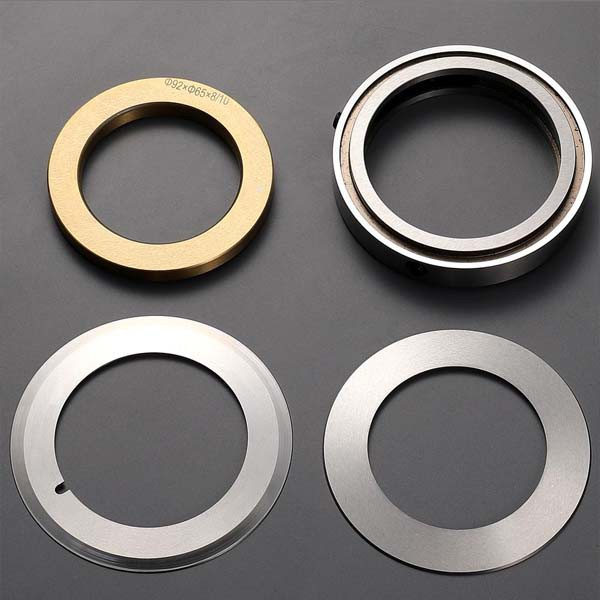
2. Circular / Rotary Blades
Circular blades, also known as rotary blades, rotate during cutting and have become one of the most widely used industrial blades in high-speed slitting operations. Factories rely on them to process film, foil, non-woven fabric, adhesive tape, cardboard and even thin metal. Because these blades cut as they spin, they distribute wear along the entire edge, which helps extend blade life and maintain consistent cutting performance.
At high speed, both material thickness and edge geometry become critical. A smooth-edge circular blade works best for light substrates like film and foil, where low resistance and clean entry are essential. For heavier or more abrasive materials, a beveled, stepped or compound edge provides better penetration and stability. In applications with unusual tension, extreme line speed or specialty laminates, custom industrial blades based on the rotary design often deliver longer life and cleaner cuts than standard slitter blades or general-purpose machine knives.

3. Toothed Blades (Serrated Knives)
Toothed blades, often referred to as serrated knives, use a row of small, evenly spaced teeth to grip the material and control the cut. This design gives them a clear advantage when working with soft, elastic or fibrous substrates that tend to slip when using a smooth-edge industrial blade. The teeth add traction, allowing the blade to "bite" into the material and create a clean slicing action instead of dragging or stretching it.
You will commonly see toothed blades in food processing, rubber trimming, foam cutting and textile production. These applications demand precise tooth geometry, because even slight variations in spacing or shape can cause tearing, fraying or uneven edges. For specialty materials-such as tough elastomers, multi-layer fabrics or products with irregular density-factories often benefit from custom industrial blades with tailored tooth patterns to achieve smoother results and extend tool life beyond what standard industrial knives can offer.

4. Perforation Knives
Perforation knives create a series of evenly spaced holes or micro-cuts that form controlled tear lines. Manufacturers rely on these specialized industrial blades for products like packaging film, plastic bags, tissue rolls, labels and other materials that need clean, predictable tearing without damaging the rest of the sheet or roll. By adjusting the cut-to-tie ratio, perforation blades can create anything from an easy-tear opening to a strong line that holds during transport but still tears cleanly when needed.
Performance depends heavily on precision. The spacing, depth and shape of each tooth must remain consistent; even small deviations can cause tearing, weak edges or irregular product strength. When a production line handles unique substrates, multi-layer laminates or materials with variable tension, factories often turn to custom industrial blades that fine-tune tooth geometry and spacing to maintain stable, repeatable results that standard industrial knives cannot provide.

5. Guillotine Knives
Guillotine knives cut straight downward with concentrated force, making them ideal for applications that require a clean, decisive slice through thick or dense materials. You'll find these heavy-duty industrial blades in paper sheeters, food-processing systems, rubber trimming lines and metal foil converting, where accuracy and stability directly affect product quality. Their single-stroke motion gives them the ability to cut wide sheets or blocks in one clean pass.
To perform well, guillotine blades need strong steel, precise flatness and a stable body that resists flexing under load. A well-engineered knife delivers clean edges without crushing, tearing or distorting the material. When a production line handles abrasive substrates, extreme thickness or complex sheet structures, engineers often rely on custom industrial blades built on a guillotine design to achieve consistent cutting results that standard industrial knives cannot maintain over long production runs.

6. Pelletizer Knives
Pelletizer knives slice continuous plastic strands into uniform pellets, a critical step in polymer processing. These specialized industrial blades work inside wet-cut and dry-cut pelletizing systems, where they make constant contact with heated, semi-molten polymer. Because the blade meets high temperature, friction and steady abrasion at every rotation, pelletizer blades must hold sharpness and resist wear far better than general-purpose industrial knives.
Material selection plays a major role in performance. If the steel is too soft, the edge wears out quickly; if it's too hard, the blade may chip when hitting filled or reinforced polymers. This balance is why many factories choose custom industrial blades with tailored hardness, edge geometry and surface treatment. A properly engineered pelletizer knife ensures consistent pellet size, stable production and fewer blade changes-key factors in maintaining efficiency for compounding and extrusion lines.

7. Razor Blades
Industrial razor blades are extremely thin, sharp and precise, making them ideal for cutting lightweight materials where edge quality is critical. These fine-edge razor blades handle plastic film, polyester, BOPP, PET, aluminum foil and multi-layer laminates-materials that demand low resistance and a clean, controlled entry point. In high-speed slitting lines, they often outperform thicker slitter blades because they slide through delicate substrates with minimal distortion.
To work effectively, industrial razor blades need exceptional sharpness and a highly polished surface. A smooth finish reduces friction, heat generation and edge buildup, all of which can cause film wrinkles, melted edges or dust. When a production line runs specialty films, abrasive additives or ultra-thin gauges, factories often rely on custom industrial blades engineered with specific coatings or edge angles to maintain stability and consistent cut quality.
Cutting Edge Styles and Bevel Types
The cutting edge is the most important part of any industrial knife. Edge geometry controls sharpness, strength and cut quality. Different industries rely on different bevel types to achieve the desired performance.
- Single-Bevel Blades
A single-bevel blade has one angled side and one flat side. This design creates a strong edge and a predictable cutting direction. It works well for slitting film, trimming rubber and cutting soft materials.
- Double-Bevel Blades
A double-bevel blade has symmetrical angles on both sides. It slices cleanly and reduces cutting force. Many applications, including plastic film, paper, tape and textiles, use this style.
- Compound Bevels
Compound bevels use multiple angles to balance sharpness and durability. These edges appear in high-speed lines where the blade needs to resist chipping while staying sharp.
- Hollow Ground, Chisel Edge and Toothed Edge
Hollow ground edges reduce surface contact to create very sharp cutting action. Chisel edges deliver directional control and appear in certain packaging lines. Toothed edges increase grip on soft materials.
Every edge style solves a specific problem. The right choice reduces resistance, improves cut quality and extends blade life.
Knife Edge Grinding Techniques
Edge grinding shapes the blade and determines its performance. Precision grinding ensures a consistent bevel angle, smooth surface finish and accurate sharpness.
During grinding, the manufacturer controls heat to avoid damaging the steel. A high-quality grind prevents micro-cracks and enhances lifespan. Smooth surfaces reduce friction and lower energy consumption. Consistent geometry helps the machine run with less vibration and creates cleaner product edges.
At SHJ KNIFE, grinding accuracy is one of the most important steps in production. Our technicians monitor every detail, from surface roughness to edge symmetry, to ensure stable performance on high-speed cutting lines.
Materials Used for Industrial Blades
The performance of industrial blades depends heavily on the material behind the cutting edge. Different blade materials change how an industrial knife handles heat, pressure, abrasion and long production cycles. Some materials hold sharpness longer, some resist corrosion, and others stand up better to fillers, adhesives or high-speed slitting. This is why engineers and buyers often compare materials before choosing any industrial blades for their equipment.
Understanding what each material does-its strengths, limitations and best applications-helps prevent issues like chipping, premature wear or unstable cutting. It also helps teams match the right steel grade or carbide option to the substrate they process. The table below summarizes the most common materials used in industrial knives, giving you a clear, quick reference when selecting the right material for your cutting environment.
|
Material Type |
Key Strengths |
Best Applications |
Limitations |
|
Hard, durable, long-lasting sharpness |
Paper, film, rubber, adhesives |
Can chip under heavy impact |
|
Handles high heat, strong under pressure |
Metal cutting, heavy-duty slitting |
Costs more than tool steel |
|
Extremely hard, longest wear life |
Abrasive materials, reinforced film, foil |
Brittle, higher cost |
|
Rust-resistant, hygienic |
Food processing, medical packaging |
Dulls faster than other steels |
Coatings for Industrial Machine Knives
Coatings help industrial machine knives perform better without changing the steel underneath. They reduce friction, increase wear resistance, prevent sticking and help blades stay stable during long, high-speed production cycles.
|
Coating Type |
Key Benefits |
Best For |
Limitations / Notes |
|
Hard surface, good wear resistance |
Film, foil, light plastics, general packaging |
Moderate friction reduction;cost-effective |
|
|
Stronger than TiN, better abrasion resistance |
Rubber, adhesive materials, medium-abrasive films |
Slightly higher cost;may require precise edge prep |
|
Excellent heat resistance, stable at high speeds |
High-speed packaging lines, abrasive laminates |
Dark coating color;higher temperature during grinding |
|
Ultra-low friction, anti-stick performance |
Adhesive films, tapes, labels, thin plastics |
More expensive;best for low-load slitting |
|
Heat-resistant, strong protective barrier |
Continuous cutting, abrasive fillers, heat-generating processes |
Brittle vs. DLC;needs careful application |
Common Industry Applications
Industrial blades are everywhere in modern manufacturing. Below are the industries that rely on them most.

Paper and Pulp Converting
Blades slit, trim and sheet paper, cardboard, tissue, release liners and label stock. Clean edges prevent dust and improve print quality.

Plastics and Film Manufacturing
Rotary blades, razor blades and slitter knives handle BOPP, PET, PE, PP, PVC, shrink film, laminates and composite materials.

Rubber and Foam Processing
Toothed blades and straight knives cut dense rubber sheets, foam blocks and flexible materials used in automotive and packaging.

Food Processing
Circular knives, straight knives and serrated blades slice meat, cheese, vegetables and baked goods. Stainless steel is common for sanitation.

Metal Industry
Rotary blades and guillotine knives cut thin metal foil, aluminum sheet and specialty alloys used in electronics and packaging.

Textile Manufacturing
Blades trim fabric, non-woven material, fiber rolls and insulation. Edge quality helps prevent fraying.
How to Choose the Right Industrial Blade ?
Choosing the right industrial blade depends on several practical factors. A good match between blade and application increases efficiency and reduces maintenance. Consider these points:
- Material hardness: Harder blades last longer but may chip. Softer blades resist impact but wear faster.
- Cutting speed: High-speed applications need stable edges and smooth surfaces.
- Edge type: The bevel angle affects cutting force and material finish.
- Coating needs: Certain materials benefit from friction-reducing or non-stick surfaces.
- Machine compatibility: The blade must match the machine tolerance and mounting design.
- Product tolerance: Some products require clean edges; others need perforation or serration.
- Customization: Custom geometry may solve problems that standard blades cannot.
A professional industrial blade manufacturer helps select the right combination of edge, material and coating for each application.
Why Work with a Professional Industrial Blade Manufacturer ?
Quality industrial blades rely on precision engineering, stable heat treatment, accurate grinding and strict material control. A professional manufacturer optimizes each of these factors.
SHJ KNIFE has delivered industrial blades for more than 25 years. We understand the needs of high-speed slitting, packaging, converting and processing industries. We use high-grade steel, modern grinding systems and advanced heat treatment technology to ensure stable and repeatable cutting performance. Working with a specialist reduces trial-and-error, improves product quality and saves downtime.
Conclusion
Industrial blades form the backbone of material processing in modern factories. They cut, slit, trim, perforate and shape countless products used in daily life. Understanding the types, edges, materials and coatings helps manufacturers choose the right blade and achieve better results on the production line.
Whether you work in paper converting, plastic film, rubber processing, packaging, textiles or food production, the right industrial blade improves efficiency and consistency. With the proper design and expert support, a blade becomes more than a cutting edge-it becomes a reliable part of your production system.
FAQ for "What Is Industrial Blades?
1. What are industrial blades used for?
Industrial blades cut, slit, trim or perforate materials like paper, plastic film, rubber, foam, textiles, food and thin metal. They help factories produce clean edges, reduce scrap and keep production running smoothly.
2. What are the most common types of industrial blades?
The most common types include straight knives, circular blades, toothed knives, perforation knives, guillotine knives, pelletizer knives and industrial razor blades. Each type fits a specific material and cutting method.
3. What materials are industrial blades made from?
Industrial blades usually use tool steel (D2, SKD11), high-speed steel (HSS), tungsten carbide or stainless steel. The material choice affects durability, sharpness and cutting performance.
4. Why does bevel type matter in industrial blades?
Bevel type controls how easily a blade penetrates the material. Single-bevel edges give directional control. Double bevels cut with low resistance. Compound bevels balance sharpness and strength for high-speed cutting.
5. What industries rely most on industrial blades?
Paper converting, plastic film manufacturing, packaging, food processing, rubber and foam production, metal foil processing and textile manufacturing all depend on machine knives for daily operations.
6. How do I choose the right industrial blade?
Match the blade to your material, cutting speed, edge type, machine tolerance and coating needs. A professional manufacturer can adjust bevel angle, steel hardness and blade geometry for better performance.
7. What is the difference between industrial blades and regular knives?
Industrial blades work inside machines and handle continuous, high-speed cutting. They use stronger steel, precision grinding and exact bevel geometry. Regular knives target manual use and cannot meet industrial demands.
8. Why do some industrial blades need coating?
Coatings like TiN, TiCN, TiAlN and DLC reduce friction, prevent sticking and resist abrasion. They help blades last longer and run cleaner, especially in film, foil and adhesive applications.
9. How long do industrial blades last?
Blade life depends on steel type, cutting speed, coating, material abrasiveness and maintenance. Carbide and coated blades last the longest, while standard tool steel works well for general use.
10. What causes industrial blades to wear out?
Abrasive materials, high heat, poor lubrication, incorrect bevel angle or low-quality steel can speed up wear. Good heat treatment and proper grinding extend blade life.
11. Can industrial blades be customized?
Yes. Custom industrial blades allow exact bevel angles, special tooth designs, specific hole patterns, surface finishes and material upgrades to match unique production needs.
12. Are circular blades better than straight blades?
Neither is "better." Circular blades suit continuous slitting at high speed. Straight knives handle wide-width sheeting and downward cutting. The right choice depends on your machine and material.
13. What is knife edge grinding in industrial blades?
Knife edge grinding shapes the bevel, sharpens the edge and polishes the surface. Good grinding reduces friction, improves cut quality and keeps the blade stable at high speed.
14. Why is steel hardness important for industrial blades?
Harder steel stays sharp longer but may chip on impact. Softer steel resists shock but wears faster. Choosing the right hardness improves cutting efficiency and blade lifespan.
15. When should a factory upgrade to carbide blades?
Factories upgrade to carbide when cutting abrasive materials, running high-speed lines or needing long intervals between blade changes. Carbide offers superior wear resistance and stable performance.
16. What problems can the wrong industrial blade cause?
The wrong blade can cause poor cut quality, dust, rough edges, tearing, machine vibration, high scrap rates and frequent downtime. Correct blade design solves most of these issues.
17. How do coatings help with adhesive materials?
Coatings like DLC and TiN reduce drag and stop glue from sticking to the edge. This helps blades cut tape, labels and laminated film without buildup.
18. Can industrial blades be resharpened?
Yes. Many tool-steel blades can be resharpened multiple times if the core material stays intact. Carbide blades often need specialized sharpening.
19. What tolerances matter for industrial blades?
Thickness, flatness, concentricity, bevel accuracy and surface roughness all affect performance. Tight tolerances ensure clean cuts and stable running on high-speed machines.
20. Why should I buy industrial blades from a professional manufacturer?
A professional manufacturer delivers stable steel quality, accurate heat treatment, precise grinding and consistent tolerance control. This leads to better cut quality, higher speed and longer blade life.


