


D2, HSS or Carbide? Choosing a Bottom Slitter Knife Material
Introduction
You may already have a bottom slitter knife that cuts well enough. The problem is that it needs changing sooner than you would like.
At that point, the usual discussion starts: stay with D2, move to M2 HSS, or spend more on carbide?
There is no useful answer without looking at the line itself.
A more wear-resistant material can help, but only when wear is actually the thing holding production back. On some lines, D2 already does the job at the right cost. On others, longer runs or more abrasive stock make M2 a sensible step up. Carbide can be valuable when wear-related downtime becomes expensive, but it is not automatically the right choice simply because it is harder.
For bottom slitter knives, material choice is usually a balance between substrate, line speed, run length, wear behavior, edge stability and the cost of stopping production.
Quick selection view
D2 is often enough when the current knife already reaches the planned maintenance window. M2 HSS becomes worth comparing when D2 wears normally but too quickly for longer or heavier-duty runs. Tungsten carbide becomes more attractive when abrasion and wear-related downtime are large enough to justify the higher tooling cost-and the cutting system is stable enough to use that extra wear resistance.

Article Summary
- Introduction
- 1. Do You Really Need a Different Knife Material?
- 2. Is a Harder Bottom Slitter Knife Always Better?
- 3. When Is D2 the Right Choice for a Bottom Slitter Knife?
- 4. When Does M2 HSS Make More Sense Than D2?
- 5. When Is Tungsten Carbide Worth the Extra Cost?
- 6. D2 vs M2 HSS vs Carbide: What Changes in Real Production?
- 7. How Do Substrate, Line Speed and Abrasiveness Change the Choice?
- 8. Your D2 Knife Is Working-When Is an Upgrade Actually Worth Paying For?
- 9. Are You Comparing Knife Price-or Cost per Cut?
- 10. What Should You Tell Your Knife Supplier Before They Recommend a Material?
- Frequently Asked Questions
- Choose the Material Around the Production Requirement
1. Do You Really Need a Different Knife Material?
The first question is not "Which grade should I buy?"
It is "What changed?"
If a line has been running well with D2 for years and the knife suddenly starts producing poor edges, upgrading the steel grade may not solve anything.
A material review makes more sense when the production requirement itself has changed. For example:
- a new paper grade contains a more abrasive coating or filler;
- average line speed has increased;
- runs are longer than they used to be;
- the knife still wears normally, but no longer lasts until the next planned stop.
Those are good reasons to look at material again.
A sudden rise in dust, burrs or ragged slit edges is different. That may point to knife condition, mounting, rotation, or the interaction between the top and bottom knives.
If that is the problem you are seeing, it is better to diagnose the cutting condition first rather than assume the knife material is too soft.
See our Bottom Slitter Knife Dust, Burr & Ragged Edge Troubleshooting guide for that topic.
Keep the two questions separate: a sudden cut-quality problem is a troubleshooting issue; predictable wear that no longer fits the production cycle is a material-selection issue.
2. Is a Harder Bottom Slitter Knife Always Better?
Not necessarily.
Hardness is easy to compare because it gives buyers a number. Unfortunately, that number does not tell you how well the knife will behave on a real machine.
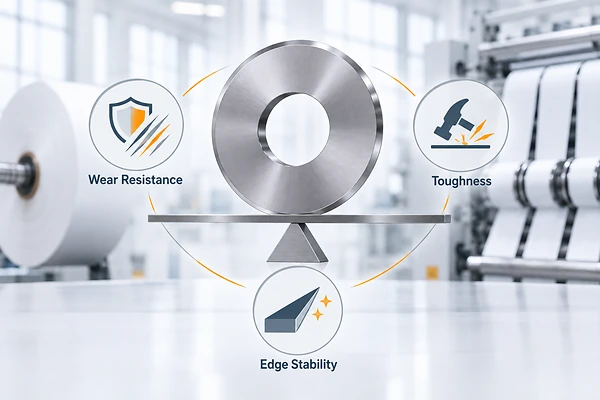
A bottom knife needs enough wear resistance to survive the intended run, but it also needs to stay stable under the actual working conditions of the line.
D2, M2 HSS and carbide all approach that balance differently.
A material with higher wear resistance may hold its surface longer, but that does not mean it will tolerate shock or abnormal contact better. Carbide is a good example. Its wear resistance is excellent, which is exactly why it is used in demanding applications. At the same time, it is less forgiving of impact than tool steel.
If the line is stable and wear is the main problem, that trade-off can make sense.
If the knife is seeing vibration, impact or irregular contact, simply choosing a harder material may create a new problem instead of solving the old one.
Engineering note: material grade should not be used to compensate for an unstable knife pair, holder or operating condition. A harder material can change the failure mode without fixing the cause.
For most applications, the practical question is not how hard the knife is. It is how long the edge stays usable under your actual production conditions.
3. When Is D2 the Right Choice for a Bottom Slitter Knife?
D2 is sometimes described as the "standard" option, which can make it sound like something you should eventually replace with a higher grade.
That is not always the case.
For many paper, paperboard, film and general converting lines, D2 gives a useful balance of wear resistance, stability and cost. If the material being slit is not highly abrasive and the knife reaches the normal maintenance window without causing an extra stop, there may be little reason to change it.
This is especially true on lines that already stop regularly for product changes or scheduled maintenance.
Suppose the knife could theoretically last longer if you moved to M2. If production is going to stop anyway before the extra life is used, then the longer life has limited value.
That is why D2 should not be judged simply as the cheapest grade in a comparison table.
In the right application, it may already be the lowest-cost solution.
For material-level background, Uddeholm's Sverker 21 / AISI D2 technical reference describes D2 / 1.2379 as a high-wear-resistance cold-work tool steel used in shearing and industrial-knife applications. That supports the wear-resistance side of the decision, but finished knife performance still depends on heat treatment, geometry and the actual slitting duty.
4. When Does M2 HSS Make More Sense Than D2?
M2 HSS becomes interesting when D2 is still working correctly but its wear life is becoming too short for the way the line now operates.
This often happens gradually.
A plant may increase line speed. Customer orders may become larger. Production may shift from shorter batches to longer continuous runs. The knife is not failing abnormally; it simply reaches its wear limit earlier than the production team wants.
That is where M2 can earn its place.
Compared with D2, M2 offers greater wear resistance and better hardness retention under higher thermal loading. In practical terms, it can give a longer and more stable service interval in applications where D2 is starting to become the limiting factor.
That does not mean every high-speed line needs HSS.
A line that runs fast for twenty minutes at a time is very different from a slower line that runs the same product for eight hours. Maximum speed tells only part of the story.
The useful comparison is whether D2 is wearing too quickly over the actual duty cycle.
If it is, M2 may be worth the additional cost.
If it is not, moving up a grade may simply increase tooling cost without changing production output.
For high-speed-steel property context, The BÖHLER S600 high-speed-steel reference lists high wear resistance, edge stability and hot hardness among its key properties. Those properties help explain why HSS grades enter the discussion as production duty rises.
5. When Is Tungsten Carbide Worth the Extra Cost?
Carbide starts to make economic sense when wear is no longer just a tooling issue and begins to affect production.
That distinction matters.
A carbide bottom knife usually costs more than a steel knife. If the only benefit is that the knife could last longer, that is not enough on its own to justify the purchase.
The extra life has to save something.
On an abrasive application running long campaigns, frequent knife changes may mean lost production, maintenance labor and repeated setup checks. In that situation, a longer-lasting carbide knife can be attractive because it may keep the line running through a period that would otherwise require a stop.
This is where carbide is strongest: wear-heavy applications in which keeping the line running has real value.
It also has limits.
Carbide is less tolerant of impact and abnormal contact than steel. If the cutting system is unstable, the line may never benefit from the material's wear resistance because chipping or local damage occurs first.
So before moving to carbide, it is worth asking two separate questions:
- Is wear really the reason we are changing knives?
- Can the machine run the carbide knife in a stable enough condition to use the extra life?
If the answer to both is yes, carbide deserves serious consideration.
6. D2 vs M2 HSS vs Carbide: What Changes in Real Production?
A simple material table is useful, but only if it reflects the production decision behind it.
|
What matters on the line |
D2 Tool Steel |
M2 HSS |
Tungsten Carbide |
|
Wear resistance |
Good |
Higher |
Very high |
|
Expected service interval |
Suitable for standard duty |
Longer in demanding conditions |
Very long in suitable wear-driven applications |
|
Performance on abrasive stock |
Suitable for moderate wear |
Better as wear demand increases |
Strong option when abrasion dominates |
|
Higher-speed / longer runs |
Often adequate for moderate duty |
Better suited as duty increases |
Valuable when wear reduction justifies the cost |
|
Response to impact |
More forgiving than carbide |
More forgiving than carbide |
More sensitive to shock and abnormal contact |
|
Initial tooling cost |
Lower |
Higher |
Highest |
|
Typical reason to use it |
Current life already fits the process |
D2 does not last through the required run |
Wear-related stops are becoming expensive |

There is one important limitation to any table like this.
A material name is not the whole specification.
Heat treatment, finished hardness, knife geometry, surface finish and, in the case of carbide, the carbide grade itself all affect the final result.
Two suppliers can both quote "M2" or "carbide" and still deliver knives that behave differently on the same machine.
For slitting-specific background, the DIENES Slitting Reference Guide also treats knife materials as trade-offs between wear resistance, shock resistance, temperature capability and cost rather than as a simple hardness ranking.
7. How Do Substrate, Line Speed and Abrasiveness Change the Choice?
What are you actually slitting?
The substrate often tells you more than the knife grade.
Plain paper, coated paper, board and film do not wear a knife in exactly the same way. Mineral fillers, pigments and surface coatings can make two materials with a similar thickness behave very differently at the cutting edge.
If a knife wore well on one paper grade but life dropped after a material change, the coating or filler system is worth checking before blaming the knife itself.
As the stock becomes more abrasive, wear resistance becomes more important. That may move the discussion from D2 toward M2 or carbide, but the jump should still be based on the production benefit, not the material label.
How fast-and how long-does the line run?
Line speed is usually one of the first numbers buyers provide. It is useful, but it needs context.
A short run at high speed may be easier on the knife economically than a lower-speed process that runs continuously for an entire shift.
Why?
Because the second line has fewer natural opportunities to stop and change the knife.
This is why run length matters as much as maximum speed.
When discussing material selection, it is more useful to tell the supplier:
"We normally run this material for six hours continuously at around 500 m/min"
than simply:
"Our machine can reach 800 m/min."
The first statement tells the supplier what the knife actually has to survive.

Does the knife wear gradually, or does it chip?
This is one of the most useful pieces of information a customer can provide.
If the knife wears gradually and cutting quality slowly declines, the problem may genuinely be wear life.
A more wear-resistant material could help.
If the edge develops isolated chips, dents or local damage, the situation is different. Increasing hardness or wear resistance may not address what is happening.
The top slitter blade, bottom knife and machine have to work as one cutting system. Mechanical stability and knife interaction matter just as much as the material grade.
We cover top/bottom matching, clearance and overlap separately, because those settings should not be mixed into a material-selection article.
What does one knife change cost?
This is where the material discussion becomes a production-cost discussion.
The purchase price of the knife is easy to see.
The cost of changing it may not be.
Depending on the line, a knife change can include maintenance time, line stoppage, setup checks, restart time and lost output.
On a low-volume line, that may not amount to much.
On a high-output continuous line, one avoided stop can be worth considerably more than the price difference between D2 and M2, or between HSS and carbide.
This is the point where a more expensive knife can become the cheaper option to run.
A useful buying rule: do not pay for longer knife life unless your production schedule can actually use it. Extra wear resistance has the most value when it removes a real changeover or helps the knife reach a planned maintenance window.
8. Your D2 Knife Is Working-When Is an Upgrade Actually Worth Paying For?
Production example: a coated-paper line
The line has been running D2 successfully. The question is not whether D2 can cut-it can. The question is what happens when the substrate becomes more abrasive and the required uninterrupted run becomes longer.
Take a coated-paper line using D2 bottom knives.
The cutting quality is good. The edge wears gradually. There is no unusual chipping and no obvious mechanical problem.
For a long time, the knife life matches the production schedule.
Then the job changes.
The plant begins running a more abrasive coated stock and the same product now stays on the machine for much longer campaigns.
The D2 knife still cuts well, but it now needs changing before the planned production stop.
That is a sensible time to compare M2 with D2.
If M2 allows the line to finish the campaign and change the knife during the planned stop, the additional knife price may be easy to justify.
If the application becomes even more wear-intensive and knife changes are still interrupting production, carbide may be the next material to evaluate.
Now change the production schedule.
Suppose the same line runs many short jobs and stops several times every shift anyway.
In that case, the plant may never use the extra life that carbide can provide.
The carbide knife could still last longer, but the longer life would not necessarily save production time.
That is the difference between buying knife life and buying useful knife life.
9. Are You Comparing Knife Price-or Cost per Cut?
When purchasing compares D2, M2 and carbide, the first column in the spreadsheet is usually price.
That is understandable, but it can also hide the real cost.
A simple way to look at the decision is:
A simple way to frame the decision
Cost per cut ≈ (knife cost + changeover cost + lost production) ÷ usable output from the knife
This is not meant to be a universal accounting formula. Every plant values downtime differently.
It is simply a better way to frame the comparison.
A knife that costs twice as much but avoids an extra production stop may be cheaper in use.
A knife that lasts twice as long but is always replaced during the same scheduled shutdown may offer little financial advantage.
The right material is therefore not automatically the least expensive knife, and it is not automatically the longest-lasting knife.
It is the one that fits the production cycle at the lowest practical total cost.

10. What Should You Tell Your Knife Supplier Before They Recommend a Material?
A useful material recommendation needs more than a drawing and a request for "the best grade."
At minimum, the supplier should understand:
|
Information to Send |
Why It Helps |
|
Substrate and thickness range |
Defines the basic cutting and wear demand. |
|
Coating / filler / abrasive content |
Shows whether wear resistance should carry more weight. |
|
Normal line speed |
Adds operating-load context. |
|
Typical continuous runtime |
Shows the service interval the knife must actually cover. |
|
Current knife material and life |
Creates a real baseline instead of selecting from theory. |
|
Wear or chipping behavior |
Helps separate a wear-life issue from instability or damage. |
|
Target change interval |
Connects knife life to the maintenance schedule. |
|
Top knife material, if known |
Adds cutting-pair context without turning this article into a clearance/overlap guide. |
It also helps to explain what you are trying to improve.
"Current knife lasts three shifts, but we need it to reach the weekend maintenance stop" is much more useful than "We need a better material."
The more clearly the production problem is described, the easier it is to avoid over-specifying-or under-specifying-the knife.
If you are still comparing the wider knife family before specifying a bottom knife, SHJ KNIFE also provides circular slitter blades for paper, film and packaging applications. For material selection, however, the application data above should come first.
Frequently Asked Questions
Is D2 the same as SKD11 or 1.2379?
AISI D2, JIS SKD11 and W.Nr. 1.2379 are commonly treated as corresponding or closely related cold-work tool-steel grades in industrial purchasing.
They should not, however, be treated as interchangeable without checking the specification. Chemistry limits, heat treatment and finished hardness can vary.
For slitter knives, the finished knife condition matters more than the grade name alone.
Is M2 HSS worth the extra cost over D2?
It can be, particularly when D2 wears normally but no longer lasts through the required production run.
If M2 reduces an extra knife change or brings the knife life back in line with the planned maintenance schedule, the higher purchase price may be worthwhile.
If D2 already reaches that point comfortably, there may be little benefit in upgrading.
Will a carbide bottom knife always last longer?
Carbide has much higher wear resistance than conventional tool steels, so it has strong potential for long service life.
That does not guarantee longer usable life in every application.
Impact, instability, abnormal contact, carbide grade and knife geometry can all affect the result.
Can I use carbide for the bottom knife and HSS for the top knife?
Yes, different materials can be used for the top and bottom knives.
The important point is that the pair must still work correctly as a cutting system.
Material choice alone does not determine the correct clearance, overlap or knife relationship. Those should be evaluated separately.
Choose the Material Around the Production Requirement
D2, M2 HSS and carbide are not simply three levels of the same knife.
Each one makes sense under different operating conditions.
If D2 already gives you stable cutting until the next planned stop, there may be no need to move away from it.
If normal wear is shortening the useful production interval, M2 may give you more room.
If abrasion and knife-change downtime are becoming major costs, carbide may be worth evaluating-provided the line is stable enough to use it properly.
Need a material recommendation for your bottom slitter knife?
Send the substrate, thickness range, line speed, typical run length, current knife material and current knife life. We can review the application before discussing D2, M2 HSS, carbide or another specification.
View Bottom Slitter Knife OptionsA useful recommendation starts with the application, not the most expensive material. That is how SHJ KNIFE approaches bottom slitter knife selection for paper, film and packaging converting lines.


