


Bottom Slitter Knife Troubleshooting: Dust, Burrs & Ragged Edges
Introduction
A slitting line that ran cleanly yesterday starts producing dust today. The first thought is often the same: are the knives dull?
They might be. But if you replace the knife and the same problem comes back, the blade was probably only part of the story.
In shear slitting, the bottom slitter knife does not work on its own. The top knife, bottom knife, holder, web and machine settings all meet at one very small cutting point. A change in any one of them can show up as dust, a frayed edge, burrs or inconsistent slit quality.
So before changing the knife, start with the edge. What the slit edge looks like-and when the problem started-usually tells you where to look next.
Article Summary
- Introduction
- 1. Start With the Symptom, Not the Blade
- 2. Inspect Both Cutting Edges
- 3. Check the Top and Bottom Knife Relationship
- 4. If the Defect Comes and Goes, Check Runout and the Holder
- 5. If the Knives Look Fine, Look Outside the Knife Station
- 6. Only Then Ask Whether the Knife Specification Fits the Job
- 7. A Simple Troubleshooting Example
- 8. When Does Replacing the Bottom Slitter Knife Make Sense?
- 9. What Should You Send to a Slitter Knife Supplier?
- Frequently Asked Questions
- Conclusion
1. Start With the Symptom, Not the Blade
"Poor cut quality" is too broad to be useful. Before changing machine settings, take a close look at a freshly slit edge and describe what is actually happening.
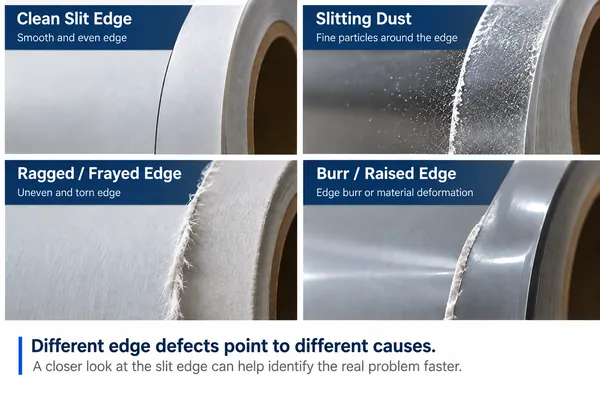
|
What You See |
Where to Look First |
Useful Clue |
|
Increasing slitting dust |
Cutting-edge wear, knife contact, overlap or process changes |
Gradual increase often points toward wear; a sudden change suggests setup or process conditions |
|
Fuzzy or frayed edge |
Knife condition, unstable engagement, holder movement or web stability |
A repeating pattern may indicate runout rather than simple dullness |
|
Burr or raised edge |
Side clearance, alignment and cutting-edge condition |
Do not automatically solve a burr by moving the knives closer together |
|
Only one lane is poor |
Individual knife, holder, mounting or runout |
A local defect usually deserves a local inspection first |
|
Several lanes change together |
Material, speed, tension or machine-wide setup |
Look for something that recently changed across the whole process |
Timing matters as much as appearance. If dust slowly increases during a production run, edge wear becomes a stronger suspect. If the problem starts immediately after a knife change, setup adjustment or new material batch, investigate that change first.
This simple distinction can save a surprising number of unnecessary knife changes.
2. Inspect Both Cutting Edges
Start with the simplest check, but do not inspect only the bottom knife.
In a shear-slitting system, the condition of the top slitter blade can affect dust and edge quality just as much as the lower knife. A new bottom knife running against a worn or damaged top knife may still produce a poor slit.
Look for:
- Uneven wear along the cutting edge
- Small chips or local edge damage
- Unusual polished contact areas on the knife face
- Adhesive, coating or material buildup
- One section wearing faster than the rest of the circumference
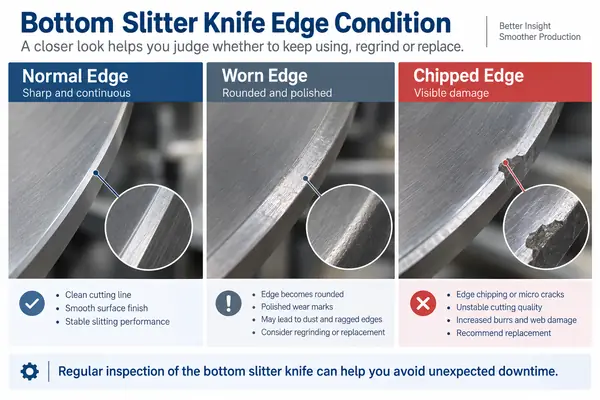
If your machine setup allows it, compare the suspect station with one that is cutting well. If the defect moves with the knife, the blade itself deserves more attention. If the defect stays at the original station, continue with the holder, mounting and alignment.
That comparison is usually more useful than changing several machine settings at once.
3. Check the Top and Bottom Knife Relationship
Many slitting problems begin when a previously stable relationship between the top and bottom knives changes.
Three areas deserve attention: side clearance, knife overlap and actual knife contact.
Knife overlap
Insufficient overlap can make the cut unstable, but excessive overlap is not automatically better. Too much engagement can increase knife-face contact and friction, alter the cut point and shorten knife life.
This is not just a theoretical concern. Converting Quarterly's technical discussion of shear-knife overlap notes that overlap can affect finished slit quality, dust generation and knife life.
Side clearance
Too much clearance can allow the web to deform before it separates. Too little can make the knives rub harder than intended.
One production-floor habit causes a lot of unnecessary trouble: the edge looks bad, so the operator keeps moving the knives closer together.
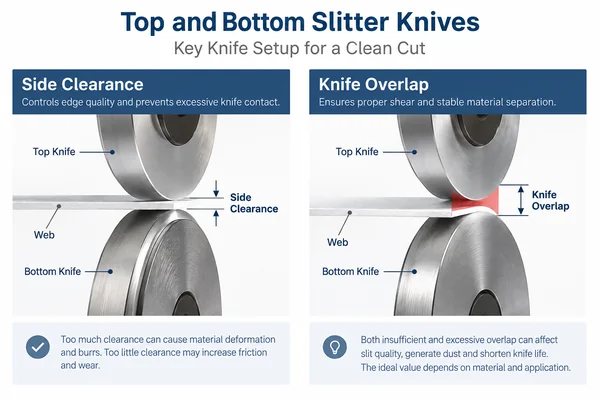
Sometimes the cut improves temporarily. Then contact increases, wear accelerates and the dust returns.
If the line was running well before a knife change or adjustment, check the top-to-bottom relationship before deciding that you need a harder blade.
4. If the Defect Comes and Goes, Check Runout and the Holder
Knife wear normally produces a problem that becomes progressively worse. A defect that appears, disappears and then repeats at regular intervals points in a different direction.
Check:
- Knife mounting surfaces
- Knife seating and positioning
- Holder stability
- Bearing condition
- Radial runout
- Axial movement or vibration
A useful clue is a repeating defect along the web. If a rough area returns at a regular distance, something may be changing once per knife revolution.
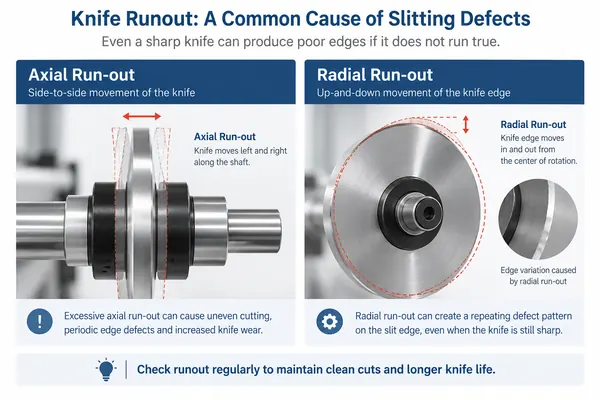
Industry troubleshooting references also identify excessive knife runout, vibration, worn bearings and incorrect knifeholder positioning among common contributors to slitting dust. This technical overview of slitting-related web defects provides a useful reference for maintenance teams.
If five lanes are cutting cleanly and only one repeatedly produces a rough edge, start with that station. There is little reason to blame the knife grade across the whole machine.
5. If the Knives Look Fine, Look Outside the Knife Station
Not every slitting defect is a knife problem.
Once the cutting edges and knife setup look reasonable, ask a simple question:
What changed before the problem started?
For example:
- A new material batch or supplier
- A different web thickness or coating
- Higher line speed
- A tension change
- Recent machine maintenance
- A replaced holder or bearing
This step is easy to miss because dust and poor edges are visible right at the knife. The original change, however, may have happened somewhere else in the process.
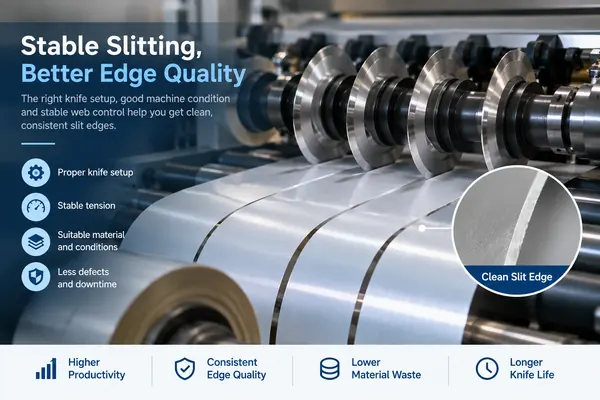
That matters especially in paper, film and flexible packaging converting, where web stability at the cutting point directly affects how consistently the material separates.
If several knife stations develop the same problem at the same time, look for a system-wide change before replacing every blade on the machine.
6. Only Then Ask Whether the Knife Specification Fits the Job
If mounting, top-to-bottom knife relationship and production conditions all check out, but the blade still wears quickly or cannot maintain a stable cut, it is time to look at the knife specification itself.
Useful questions include:
- Does the current material provide enough wear resistance?
- Is the edge geometry suitable for the substrate?
- Is the knife surface condition appropriate for the operating speed?
- Are the top and bottom knives working as a suitable pair?
One point is worth stating clearly: harder is not automatically better.
HSS, carbide and other tool steels each have applications where they make sense. If the real problem is poor alignment, excessive knife contact or unstable rotation, changing from HSS to carbide will not make the setup correct.
Choose the blade material after the operating problem is understood, not before. Material selection deserves its own discussion because substrate, speed, abrasiveness, expected knife life and total operating cost all matter.
7. A Simple Troubleshooting Example
Imagine a film slitting line that has always run cleanly but has recently started producing edge dust.
The least useful first question is:
"What knife material should we buy?"
A better question is:
"When did the dust start?"

If it started immediately after installing a new knife set
Check mounting, alignment and the top-to-bottom knife relationship first.
If the new knives were clean at first and dust gradually increased
Edge wear and actual knife life become much more relevant.
If several lanes changed after line speed was increased
Start with the overall process conditions rather than replacing individual knives.
The visible symptom is the same in all three cases: dust. The likely cause is not.
That is why "we have slitting dust-what blade should we use?" rarely gives a knife supplier enough information to recommend the right solution.
8. When Does Replacing the Bottom Slitter Knife Make Sense?
After the checks above, replacement becomes a more reasonable next step when you can see a clear link between the knife and the defect.
- The cutting edge shows obvious wear, chipping or damage.
- A known-good knife solves the problem at the same station.
- The defect moves when the suspect knife is moved to another position.
- Knife life has dropped significantly although the production process has not changed.
- The existing blade can no longer maintain the dimensional or surface condition required for the job.
At that point, discussing a precision replacement bottom knife makes sense.
If the knife has simply reached normal wear rather than suffering damage, there is still another question to answer: is it worth regrinding, or is replacement more economical? That decision should be based on remaining geometry, blade condition, required cut quality and production cost-not a fixed number of operating days.
9. What Should You Send to a Slitter Knife Supplier?
You do not need a long technical report to start a useful conversation with a blade supplier. A few specific details are far more helpful than simply asking for "the best blade."
- Material being slit
- Material thickness
- Normal line speed
- Bottom knife OD × ID × thickness
- Current knife material
- Top knife type or specification
- Machine model
- Whether the defect affects one lane or all lanes
- Close-up photos of the slit edge
- Photos of the used knives
- Any recent change in material, speed or knife setup
SHJ KNIFE manufactures circular slitter blades for paper, film and packaging applications, but a useful recommendation still starts with understanding what is happening on the customer's line.
Sometimes the right answer is a different bottom knife. Sometimes it is a setup or machine issue. Finding that out first is usually cheaper than treating every edge problem as a blade purchasing problem.
Frequently Asked Questions
Why is my slitter producing so much dust?
First check whether the dust is limited to one knife station or appears across several lanes. A local problem points more strongly toward blade condition, holder condition or runout. If several lanes change together, also check material, line speed, tension and overall knife setup.
Why am I getting ragged edges even with a new slitter knife?
A new knife cannot correct an unstable cutting system. Incorrect top-to-bottom knife setup, runout, holder movement or unstable web conditions can still produce fuzzy or ragged edges with a new blade installed.
Should I reduce knife clearance whenever I see a burr?
Not automatically. Excessive clearance can contribute to poor edge formation, but making the knives too tight increases contact and friction. Check the edge pattern and make one controlled adjustment at a time.
Is a carbide bottom slitter knife always better than HSS?
No. Carbide offers excellent wear resistance, but the right material depends on the substrate, production speed, knife geometry, machine stability and required service life. A material upgrade will not correct an alignment or setup problem.
The Useful Question Is Not "Which Knife Should I Replace?"
When dust, burrs or ragged edges appear, the more useful first question is:
What changed in the cut?
Look at where the defect appears and when it started. Then work through the cutting edges, the relationship between the knives, the holder and the process conditions.
Only after those checks does it make sense to discuss knife material or replacement.
If you are troubleshooting a current slitting problem, send SHJ KNIFE your OD × ID × thickness, substrate, line speed, machine model and clear photos of the slit edge. That gives us enough context to discuss the problem first-and the blade second.


