


Top & Bottom Slitter Knife Matching: Why Size Isn’t Enough
Introduction
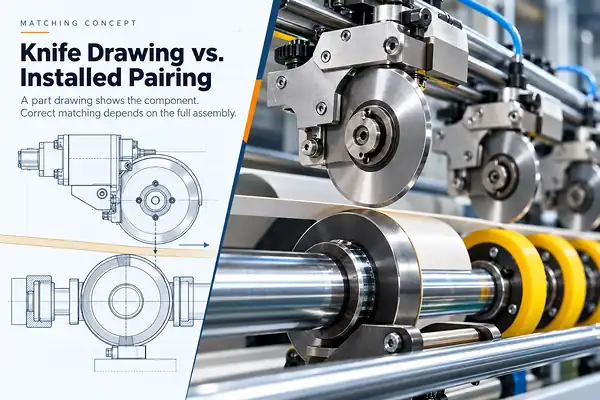
In our work with paper converting customers, a replacement enquiry often starts with a bottom slitter knife drawing and a request to supply the same dimensions. That is a sensible starting point. The difficulty comes when the drawing is expected to answer a second question: will the new knife work correctly with everything already on the machine?
That is where top and bottom slitter knife matching needs closer attention.
For the customer, the concern is practical. A planned knife change should fit into the maintenance schedule, not leave the production team waiting through repeated adjustments and trial cuts. When the replacement fits the shaft but the cut still needs work, purchasing wants to confirm that the right knife arrived, while maintenance needs to understand what to change.
As a knife supplier, we need to help connect those two questions. Confirming the replacement against its drawing is part of the job. Understanding its relationship with the existing top knife, holder and web path is the next part.
This article explains how we approach that discussion for rotary shear slitting of paper, paperboard and related packaging webs. It is especially relevant when you plan to replace one knife while keeping the other in service.
Quick engineering view
A replacement knife can match the drawing and still need a pairing review. Diameter, bore and thickness confirm the component, but the working profiles, mounting references, retained knife condition, holder arrangement and web path determine how the top and bottom knives work together after installation.
Article Summary
- Introduction
- 1. Why We Ask About the Machine Before Recommending a Pair
- 2. What We Look at Beyond Diameter, Bore and Thickness
- 3. How Geometry and Holder Settings Come Together
- 4. The Holder Must Preserve the Relationship Between the Knives
- 5. Material Selection Should Include the Knife You Are Keeping
- 6. What a Complete Knife-Change Review Looks Like
- 7. What to Include in Your Pairing Enquiry
- Frequently Asked Questions
- Planning Your Next Replacement?
1. Why We Ask About the Machine Before Recommending a Pair
When a customer asks us to assess a replacement knife, the machine arrangement gives meaning to the drawing. We need to understand how the equipment positions the upper knife, which face of the lower knife it works against, and how the paper reaches the cutting point.
A shaft-mounted assembly and an individual top knifeholder do not establish that relationship in the same way. The web may also pass tangentially through the cutting area or wrap around the bottom knife. The DIENES Slitting Reference Guide describes these distinctions in shear slitting arrangements.
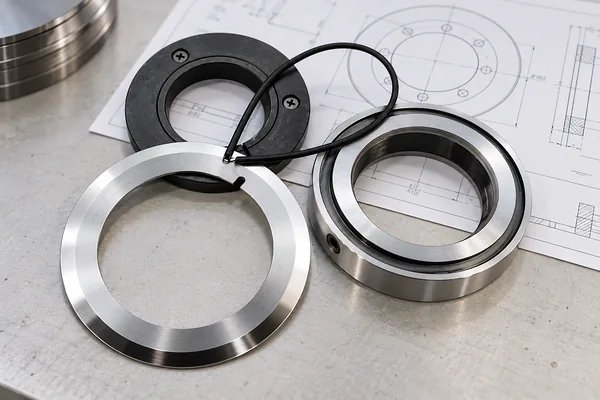
This is why we may ask for an installation photograph even when you have already supplied a detailed knife drawing. The drawing tells us about the component; the photograph helps us understand its place in the assembly. A clear view of both knives, the holder and the web direction is usually more useful than several close-ups of the new knife alone.
The arrangement also determines how we should discuss slitter knife clearance for paper. On a side-loaded shear system, the relevant question concerns the intended lateral contact and loading. Treating that system as though it requires a fixed gap calculated from paper thickness can lead the discussion in the wrong direction. We first establish the mechanism, then refer to the instructions that apply to it.
The practical distinction: the drawing defines the component; the installed arrangement defines how that component works with the rest of the cutting system.
2. What We Look at Beyond Diameter, Bore and Thickness
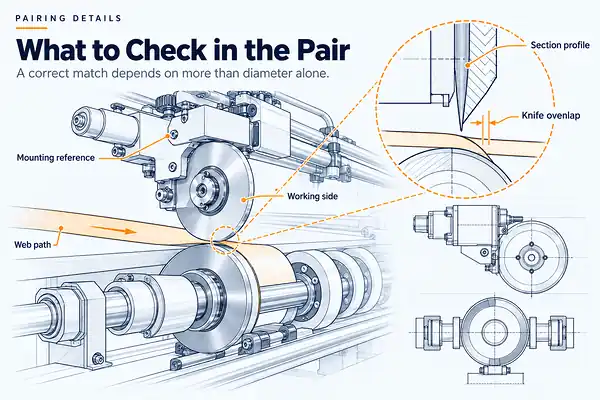
The ordering dimensions remain essential. They allow us to manufacture the part and give your incoming inspection team a basis for acceptance. For slitter knife matching, however, we also need to understand where the working edge sits once the knife is mounted.
A section drawing is particularly useful because it shows the blade profile, bevel and working face. Two knives can appear similar in an overall photograph without that photograph revealing enough about their cutting sections. DIENES also identifies blade profile and bevel angle as factors affecting the interaction between the knife and the web.
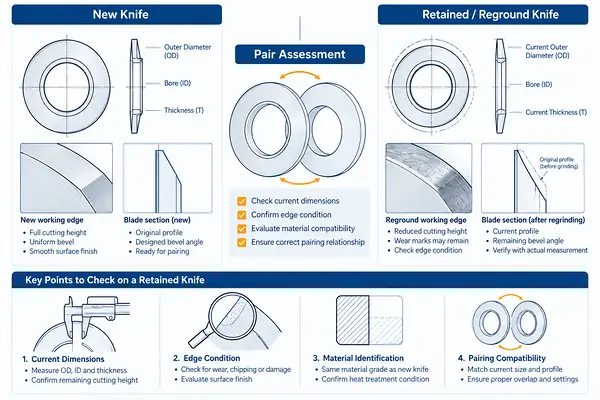
We consider those features together with the mounting references. The locating face and bore establish how the knife sits on the machine, while the cutting section establishes the working geometry. Looking at both helps us follow the relationship from the mounting to the edge.
The knife staying on the machine needs the same attention. If the top knife has been reground, its original drawing is useful background, but the current diameter and condition are more relevant to the pair you are about to install. An enquiry that gives the new bottom knife dimensions and only the original top knife specification leaves that part of the assessment unfinished.
You do not need to arrange a complete new inspection before contacting us. Start with the information available and distinguish drawing dimensions from current measurements. The following details help keep the discussion clear:
|
Information |
What It Helps Establish |
|
Part number and drawing revision |
Which design is being supplied or retained |
|
Current dimensions |
The available measurements of the actual knives |
|
Section drawing and working side |
The profiles and faces intended to work together |
|
Mounting references |
How each knife locates in the assembly |
|
Knife condition |
Whether the retained component is new, used or reground |
3. How Geometry and Holder Settings Come Together
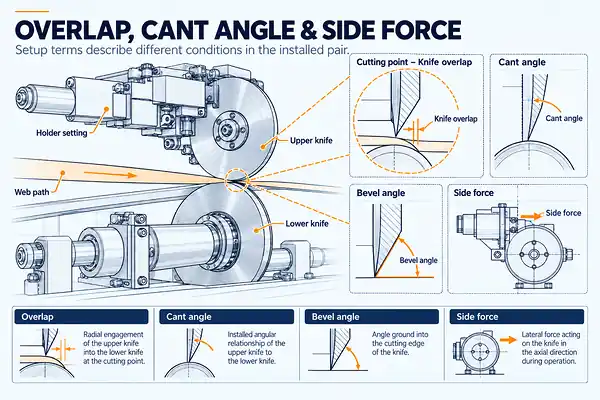
Once we understand the knives and their installation, we can have a more useful conversation about setup. This is also where terminology deserves care, because overlap, cant angle and side force describe different conditions.
|
Term |
Meaning in the Pairing Discussion |
|
Slitter knife overlap |
Radial engagement between the upper and lower knives |
|
Slitter knife cant angle |
The top knife's installed angular relationship to the bottom knife |
|
Blade bevel angle |
The angle manufactured into the cutting profile |
|
Slitter knife side force |
The lateral force associated with knife contact |
What Does Slitter Knife Overlap Mean?
Increasing overlap changes the geometry through which the paper passes. It should not be treated simply as a way to make engagement more secure. DIENES explains that excessive overlap can increase contact between the blade and the material and affect the cut point in tangential slitting. Insufficient overlap also has risks, so the objective is a setting appropriate to the installed combination.
After a knife change, that setting should be confirmed using the equipment's prescribed method. A previous adjustment position can provide a reference, but it does not establish the current overlap by itself when the knife combination has changed.
Cant Angle vs. Blade Bevel Angle
Angle terminology creates another opportunity for misunderstanding. The bevel is ground into the knife, whereas cant angle belongs to the installed arrangement. When a customer's drawing or setup note refers simply to "the blade angle," we need to establish which angle it means. We also need to know whether the holder permits routine adjustment. For example, the Tidland Performance Series Unibody Knifeholder manual describes cant-angle and knifeholder setup in the context of the specific holder configuration.
How Should Slitter Knife Side Force Be Recorded?
Side force needs similar context. A pneumatic pressure reading should be recorded with the holder model, rather than treated as a universal knife-contact force. If your setup record includes a side-force value, its source should therefore be clear: a measurement, a control-system reading or applicable manufacturer data.
Engineering note: we would not recommend a universal overlap, cant angle or pressure setting without first identifying the equipment, holder and knife combination.
If you need the next step after the pair has been identified, see our slitter blade setup guide for gap, overlap and pressure. That guide covers installation and adjustment; this article stays focused on whether the proposed top-and-bottom knife combination is suitable for review.
4. The Holder Must Preserve the Relationship Between the Knives
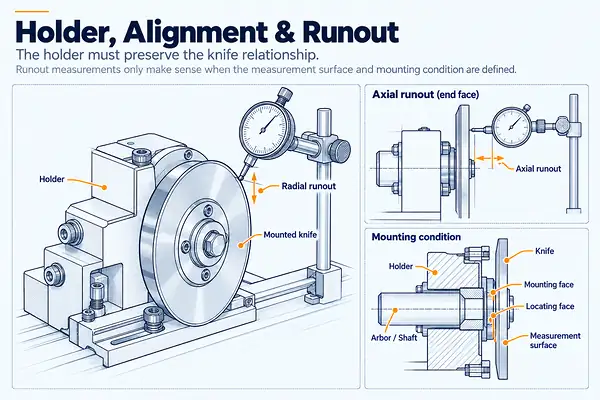
A pairing assessment cannot stop with the loose components. The holder and mounting must maintain the intended knife relationship on the machine.
DIENES discusses holder integrity, mounting conditions and axial and radial runout as factors affecting cutting geometry. Its guidance also connects knife diameter and web path with the cut point.
For this reason, existing inspection records can be valuable when we discuss top and bottom slitter knife alignment. A runout figure should identify the measured surface, the mounting condition and the acceptance requirement used. Without those details, two measurements may appear to conflict even though they describe different conditions.
Keeping those results with the knife and holder identification gives the maintenance team a reference for future replacements. It also helps separate a question about the supplied knife from one about the installed assembly.
If the line already produces dust, burrs or ragged edges, our slitting dust and edge-defect troubleshooting guide covers the wider investigation. Here, the purpose is to establish whether the assembly can maintain the conditions required by the proposed pair.
5. Material Selection Should Include the Knife You Are Keeping
Some replacement enquiries begin with a request to change material because the customer wants to address wear or extend the interval between knife changes. When discussing a replacement bottom slitter knife, we also ask what material and condition the existing top slitter blade has.
Identical grades do not, by themselves, establish a suitable pair. A proposed combination of different grades also needs assessment against the design and application requirements. If the retained knife's grade is unknown, it is better to identify that uncertainty than to assume a material from its appearance.
We keep this question separate from dimensional approval. A material recommendation does not also confirm that the profile, mounting or holder settings are suitable. For a fuller discussion of available grades, see our guide to bottom slitter knife material selection.
What matters most: the retained knife should be discussed in its current condition, not only by its original drawing or nominal material grade.
6. What a Complete Knife-Change Review Looks Like
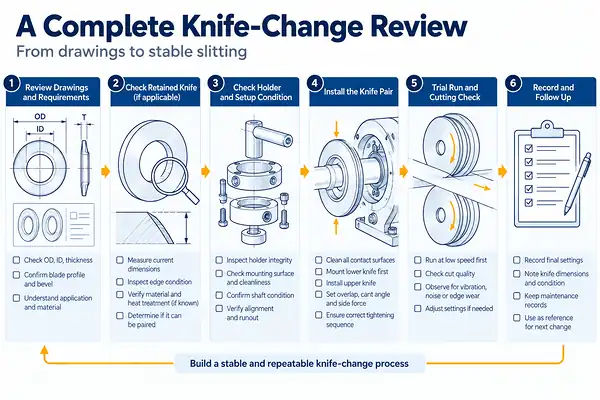
Consider an illustrative replacement: a converter receives a bottom knife made to the existing drawing, incoming inspection confirms the dimensions, and the top knife will remain in service.
At this point, purchasing has confirmed the supplied component. Maintenance still needs to assess the installed pair. The team identifies the retained top knife, checks the available measurements and condition records, and confirms the working sides and mounting references of both components.
The holder configuration is then compared with the applicable setup instructions. Previous records can help when they describe a relevant combination, but any differences need to be resolved before those settings are reused. Qualified personnel carry out inspection and adjustment under the equipment's shutdown, isolation and manufacturer procedures, followed by the approved trial-cutting process.
The trial record connects the result to the actual job. It identifies the material, thickness, speed and other required conditions, while the samples are assessed against the agreed production requirements. If an adjustment is necessary, the team records both the change and its result.
That leaves the next shift with something they can use. Instead of finding an isolated pressure reading or adjustment position, they can see which knives were fitted, what instructions applied and under which conditions the cut was accepted.
This example illustrates a review process; it is not a reported customer installation.
7. What to Include in Your Pairing Enquiry
You do not need a complete technical file to start a conversation with SHJ KNIFE. Tell us which knife you plan to replace, which components will remain in service and what you need to confirm.
For matching slitter knives for paper converting, the following information provides a useful starting point:
|
Information |
What to Send |
|
Knife drawings |
Dimensions, profiles, tolerances and revisions for both knives |
|
Retained knife details |
Available measurements, material identification and condition |
|
Installation photographs |
Both knives, the holder, working sides and web direction |
|
Holder information |
Model, configuration and available instructions |
|
Application conditions |
Material, thickness range, speed and web path |
|
Purpose of the enquiry |
Routine replacement, a specification change or a pairing concern |
If you have only the bottom knife drawing, send it and explain that the existing top knife will stay in service. We can then discuss which missing details matter most to the assessment.
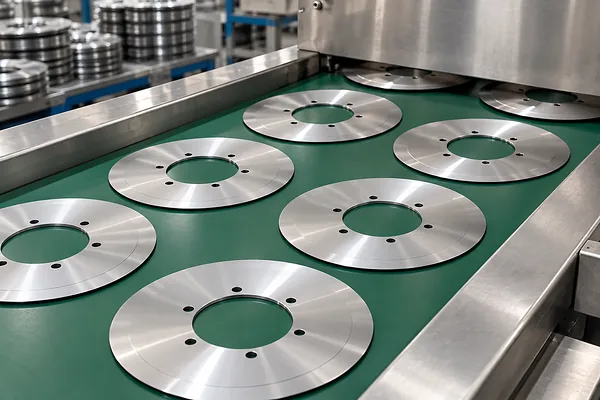
If you are still identifying the wider knife family before preparing the enquiry, you can also review our circular slitter blades for paper, film and packaging applications.
Frequently Asked Questions
Can top and bottom knives from different suppliers work together?
They may be suitable if the combination meets the knife and equipment requirements. The assessment should cover working geometry, materials and mounting details, including any equipment-specific restrictions. The supplier's name alone cannot establish compatibility.
Does buying a matched set remove the need for setup checks?
No. Ask the supplier to explain what "matched" covers, such as an agreed drawing combination. The knives still require correct installation and assessment under the applicable operating conditions.
Must both knives be replaced at the same time?
The retained knife's condition and the requirements of the proposed pair should guide that decision. Its suitability needs to be assessed before deciding whether to keep it or replace it.
How much overlap should top and bottom slitter knives have?
There is no single overlap value that applies to every shear-slitting system. The correct setting depends on the knife geometry, holder design, web path and the applicable machine or holder instructions. A previous adjustment position can be a useful reference, but it should be checked again when the knife combination changes.
What should I send when replacing only the bottom slitter knife?
Start with the bottom knife drawing and explain that the existing top knife will remain in service. If available, include the top knife's current diameter and condition, installation photographs, holder model or instructions, material and thickness range, normal line speed and web path. If the retained top knife has been reground, current measurements are more useful than relying only on its original drawing.
Planning Your Next Replacement?
When sourcing replacement slitter blades for paper, include the existing top knife in the discussion even if you are buying only the bottom knife.
Send SHJ KNIFE the available drawings, holder details and application information. Understanding what will stay on the machine helps us discuss the replacement as part of the working assembly, before the new knife reaches your production line.
Preparing a top and bottom slitter knife replacement?
Send the available knife drawings, retained-knife measurements, holder information and application conditions. We can review what still needs to be confirmed before the replacement reaches the line.
View Bottom Slitter Knife OptionsThe goal is not to turn every replacement into a large engineering project. It is to make sure the new knife is discussed as part of the actual cutting pair, rather than as an isolated diameter, bore and thickness.
No Information


